Best Accounting Software for Ecommerce 2026: An Accountant’s Picks
The best accounting software for ecommerce sellers in 2026: Xero, QuickBooks Online and Zoho Books compared for Shopify, Amazon and Etsy, plus the connectors you need and what a working setup costs.

So, you sell online and you need accounting software that can cope with Shopify payouts, Amazon settlements and Etsy fees. Most small business software can, but only when it’s connected properly. Pick the wrong setup and you’ll spend every month-end untangling deposits by hand.
I’m an accountant, and I set up books for online sellers. Below is what makes ecommerce bookkeeping different, the software I’d pick for each kind of store, the connectors that do the heavy lifting, and what a working setup really costs each month.
Quick answer
- Best overall for growing stores: Xero, from $27 a month, with unlimited users and a free Shopify integration built by Xero.
- Best if your accountant uses QuickBooks: QuickBooks Online, from $38 a month, with Intuit’s own Shopify connector included. Inventory tracking needs Plus at $140.
- Best on a budget: Zoho Books, from $15 a month billed yearly, especially if you also use Zoho Inventory.
- Selling on Amazon, eBay or Etsy too? Add a settlement connector such as A2X, from $29 a month.
- Skip for a real store: FreshBooks and Wave. They’re built for invoicing, not marketplace payouts.
Xero partner offer · ends 31 March 2027
80% off Xero for 6 months
Unlimited users on every plan, a free Shopify integration built by Xero and 1,000+ connected apps including A2X.
Why Ecommerce Bookkeeping Is Different
Here’s the bit that catches most new sellers: the money landing in your bank isn’t your revenue. It’s a bundled payout that mixes sales, shipping, sales tax you collected, card or marketplace fees and refunds into one deposit.
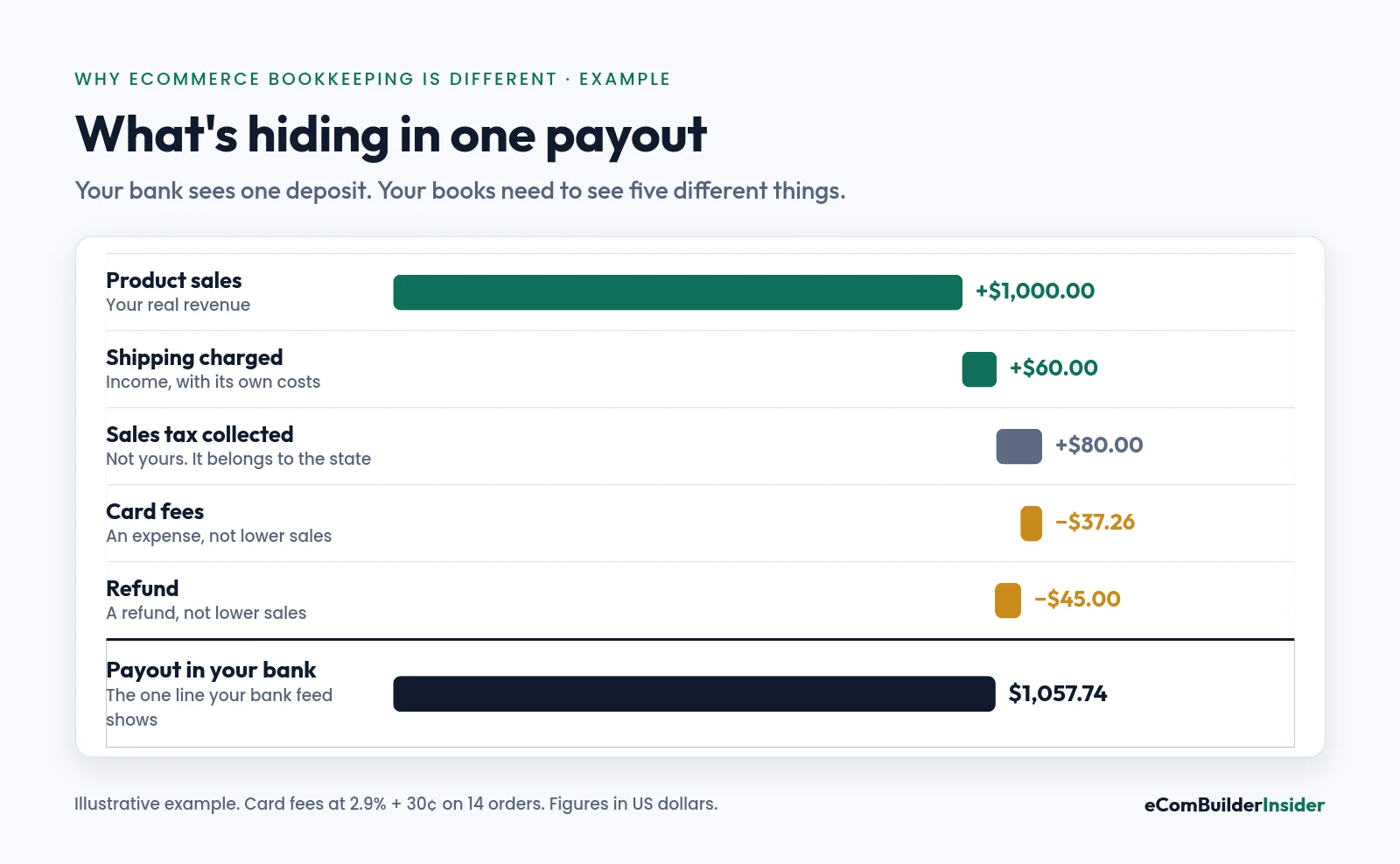
If you record that $1,057.74 as sales, three things go wrong:
- Your revenue is wrong. It’s understated by the fees and refunds, and overstated by the sales tax.
- Your sales tax is hidden. The $80 belongs to the state. It should sit in a liability account, not your income.
- Your margins look better or worse than they are, because fees and refunds disappear into a smaller number.
The fix is to record each part separately. That needs a sensible chart of accounts with lines for sales, shipping income, fees and refunds, and a monthly bank reconciliation. Good software, plus the right connector, does most of this for you.
Common mistake
Recording marketplace payouts straight to “Sales”. It’s the most common error I see in sellers’ books, and it’s the one accountants charge most to untangle at year end.
The Best Accounting Software for Ecommerce at a Glance
| Software | From (US, monthly) | Users | Shopify connection | Inventory |
|---|---|---|---|---|
| Xero | $27 | Unlimited | Free integration by Xero | Basic on all plans |
| QuickBooks Online | $38 | 1 to 25 by plan | Intuit connector included | Plus ($140) and up |
| Zoho Books | Free, or $20 ($15 billed yearly) | 1 to 15 by plan | Via connectors or Zoho Inventory | Professional and up |
| FreshBooks | $23 | Owner, plus $11 per team member | Third-party only | Limited |
| Wave | Free, or $19 | Extra users on Pro | Limited | No |
The Best Options for Online Sellers, Reviewed
1. Xero: best overall for growing online stores
I use Xero myself, and for most growing stores it’s where I’d start. Every plan includes unlimited users, so your bookkeeper, accountant and operations lead can all log in without per-seat fees.
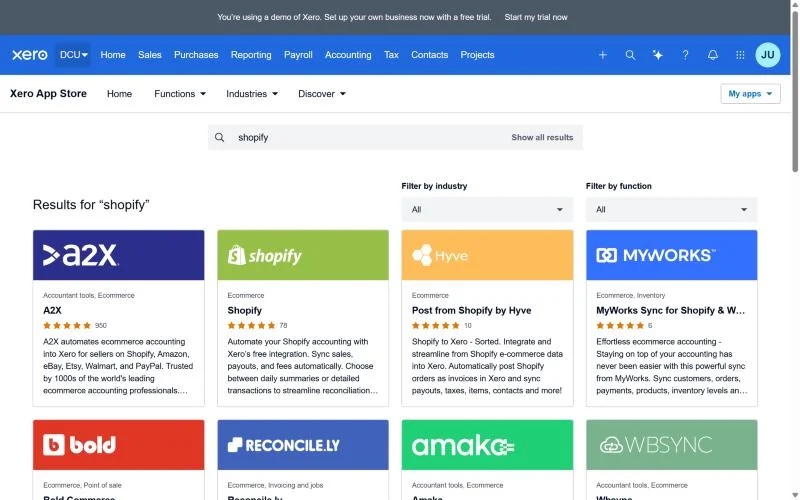
- Shopify: the Shopify integration by Xero is free on all plans. It brings in sales, payouts, fees and taxes, as a daily summary or per sale.
- Marketplaces: connect Amazon, eBay, Etsy and Walmart through A2X or a similar app from the Xero App Store.
- Multi-currency: included on Established, for sellers who sell or buy in other currencies.
- Inventory: basic tracked items on every plan. Add an app such as Cin7 for kits or several warehouses.
| Plan | Monthly | What you get |
|---|---|---|
| Early | $27 | 20 invoices and 5 bills a month |
| Growing | $59 | Unlimited invoices and bills |
| Established | $97 | Adds multi-currency, projects and expense claims |
Drawn from the table above. Lowest price highlighted.
Catch: Early’s 20-invoice limit is tight for an active store, so most sellers end up on Growing. Support is online, not by phone. More detail in my Xero for ecommerce guide and Xero pricing guide.
2. QuickBooks Online: best if your accountant works in QuickBooks
QuickBooks Online is the software most US accountants know, which counts for a lot at tax time. Intuit builds its own Shopify connector, included with your subscription, which syncs orders, payouts, fees, taxes and product data.
- Plans: Simple Start $38, Essentials $85, Plus $140 and Advanced $340 a month.
- Inventory: tracked stock with cost of goods sold is on Plus and Advanced.
- Multi-currency: Essentials and up.
- Users: 1 on Simple Start, 3 on Essentials, 5 on Plus and up to 25 on Advanced.
Catch: it costs more than Xero, especially once you add people or need inventory. My Xero vs QuickBooks comparison goes through the trade-offs in detail.
3. Zoho Books: best on a budget
Zoho Books gives you the most for the least money. Standard is $20 a month, or $15 billed yearly, and there’s a free plan for businesses with revenue up to $50K.
- Inventory: item tracking from Professional ($50, or $40 billed yearly).
- Marketplaces: Zoho Inventory, sold separately, connects to the main sales channels and feeds Zoho Books.
- Users: 3 on Standard, rising to 15 on the top plans.
Catch: fewer accountants use it, and the main settlement connectors such as A2X focus on Xero and QuickBooks. See my Zoho Books pricing guide.
Zoho Books · checked 2 Nov 2026
Try Zoho Books from $15 a month
Paid plans from $15 a month billed yearly, or a free plan while your revenue is $50K or less.
4. FreshBooks and Wave: fine for invoicing, weak for stores
Both are good at what they’re built for: sending invoices and tracking expenses for freelancers and service businesses. Neither has a strong, built-in way to split marketplace payouts or track stock, so I wouldn’t run an online store on them. If you’re selling a few items alongside freelance work, they’re fine. See my Wave review and FreshBooks review.
The Connectors That Make It Work
Even the best accounting software can’t read a marketplace settlement on its own. These tools sit in between.
A2X: the settlement connector I recommend most
A2X connects Shopify, Amazon, eBay, Etsy and Walmart to Xero or QuickBooks. It turns each payout into one clean journal that splits sales, fees, refunds and tax, and matches the deposit in your bank.
- Shopify pricing: Mini is $29 a month for up to 200 orders, Basic $45 for up to 500 and Professional $79 for up to 2,000 (A2X pricing).
- Price change: A2X says prices on plans other than Mini rise from 14 November 2026.
- Free trial: no credit card needed, and you can post 3 settlements to test it.
Other options
- Native integrations: Xero’s and Intuit’s own Shopify connections are free with your plan and fine for a Shopify-only store.
- Synder: syncs individual transactions from Shopify, Stripe, PayPal and marketplaces. Its plans are priced by monthly transaction volume, so check the cost at your volume.
- Inventory apps: Cin7 or Zoho Inventory when you outgrow basic stock tracking.
Accountant’s tip
Shopify only? Start with the free native integration. Add A2X when you add Amazon or another marketplace, or when payouts stop matching. That’s usually the point where reconciling by hand starts eating your weekends.
What a Working Setup Costs
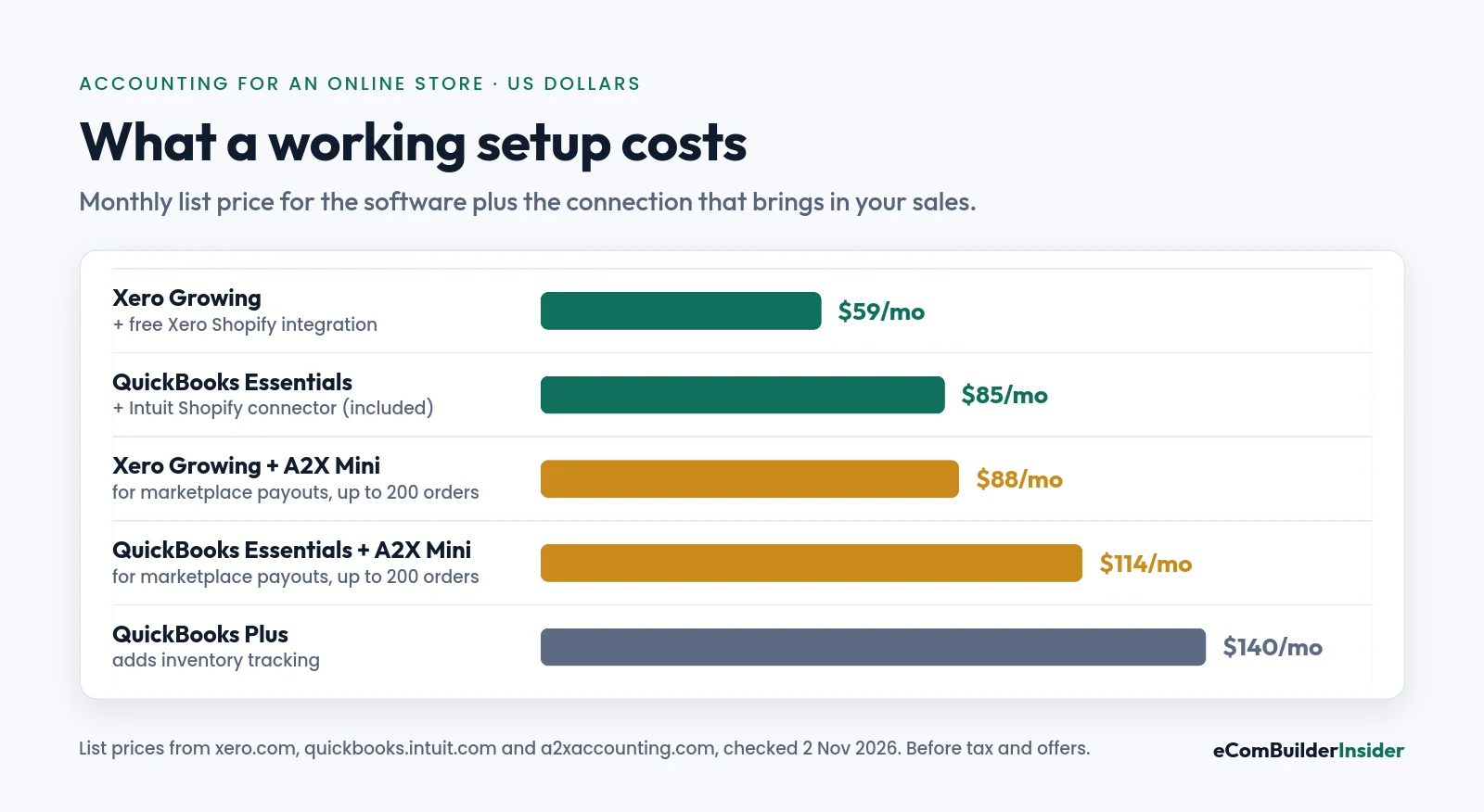
For a Shopify-only store, Xero Growing with its free Shopify integration is the cheapest complete setup at $59 a month. Add Amazon or Etsy and A2X Mini, and it’s $88. The same setup on QuickBooks Essentials is $114.
With the Xero partner offer, Growing costs $11.80 a month for your first 6 months, so year one is $424.80 before connector fees.
How to Choose Based on Your Sales Channels
| If you sell on… | I’d choose | Why |
|---|---|---|
| Shopify only | Xero Growing + free Shopify integration | Cheapest complete setup, unlimited users |
| Shopify + Amazon or Etsy | Xero or QuickBooks + A2X | A2X splits every marketplace payout |
| Amazon FBA with lots of stock | QuickBooks Plus, or Xero + an inventory app | You need cost of goods sold tracked properly |
| A few sales a month | Zoho Books or Wave | Low cost while volumes are small |
| Several currencies | Xero Established or QuickBooks Essentials+ | Multi-currency is built in |
- List your channels and your monthly order count. That decides your connector and its price.
- Ask your accountant which software they use. A familiar file usually means lower fees.
- Count the people who need access. Per-user limits push QuickBooks costs up quickly.
- Test with real data. Use the free trial to bring in one month of payouts and reconcile them.
Free tool · 4 quick steps
Get a shortlist for your store
Answer four quick questions and get accounting software that fits your size, budget and sales channels.
My Verdict
For most growing online stores, Xero plus the right connector is the setup I recommend: unlimited users, a free Shopify integration and the widest choice of ecommerce apps. Start on Growing, and add A2X when you sell beyond Shopify.
If your accountant works in QuickBooks, or you need built-in inventory and are happy to pay for Plus, QuickBooks Online is the safe choice. On a tight budget, Zoho Books is good value. Whatever you pick, the connector matters as much as the software.

Frequently Asked Questions
What is the best accounting software for ecommerce?
For most growing stores, Xero, because every plan includes unlimited users and Xero’s own Shopify integration is free. QuickBooks Online is the better fit if your accountant uses it or you need built-in inventory on the Plus plan.
Do I need A2X if I use Xero or QuickBooks?
Not for a Shopify-only store, where the free native integrations are often enough. A2X earns its cost once you sell on Amazon, eBay, Etsy or Walmart, or when your payouts stop matching your bank.
How much does A2X cost?
For Shopify, A2X Mini is $29 a month for up to 200 orders, Basic $45 for up to 500 and Professional $79 for up to 2,000. A2X says prices on plans above Mini rise from 14 November 2026.
Can QuickBooks handle Amazon FBA?
Yes, with a connector such as A2X to bring in settlements. For tracked stock and cost of goods sold, you’ll need QuickBooks Plus or Advanced, or a separate inventory app.
Should I record Shopify payouts as sales?
No. A payout is sales minus fees and refunds, plus sales tax you owe. Record each part separately so your revenue, expenses and sales tax are all correct.
How much should accounting software cost for a small online store?
A complete setup usually costs $59 to $115 a month: the software plus the connection that brings in your sales. A Shopify-only store on Xero Growing with the free integration is $59.
Is free accounting software enough for an online store?
For a hobby store, maybe. Once you’re handling regular payouts from several channels, you’ll want bank feeds and a settlement connector, which free plans don’t include.
Next steps: Xero for ecommerce · Xero vs QuickBooks · Shopify pricing plans · best free accounting software.
How this site makes money
Some links on this page are affiliate links. If you sign up through one, I may earn a commission at no extra cost to you. Read the full disclosure.